Skip to content

Showcase · status and figures as of the check date on each card

Mineral areas and assets in Kazakhstan

Areas selected by our geologists, and operating quarries and deposits offered by their owners. Name, coordinates and documents follow an NDA unless the card says otherwise.

Illustration
Showing 9
QN-110

Coal

Akmola Region

Prognostic coal resources (initial estimate under Soviet category C2):

200–500 million t

  • Hard coal, thermal grade; coals of this sequence in the district belong to grades K and G (К, Г), weakly caking, difficult to wash
  • Lower Carboniferous coal-bearing sequence about 300 m thick; the lower coal horizon is of economic interest
  • Two workable seams, combined seam thickness 29 m; coal-bearing field area about 40 km²
  • Ash content 30 to 50%; the balance estimate included coals with ash up to 45% and seam thickness from 1.5 m
  • Stage: prospecting and evaluation; on this basis a category C2 estimate was made in Soviet times, later reclassified as prognostic resources because exploration was sparse
  • Mining method: underground (given the depth of the seams)
  • Standard: Soviet classification (category C2, prognostic resources), this is not JORC

No active exploration or mining licences (per our check against the map)

Checked 12.11.2026; not an official extract.
Akmola Region · approximate place, inside the circle
QN-111

Coal

Pavlodar Region

Prognostic resources, category P2, to a depth of 300 m (geologists' estimate):

500 million – 1 billion t

  • Brown coal (lignite), Jurassic; coal-bearing graben about 8 by 10 km, area about 80 km²
  • Lower Jurassic coal-bearing deposits up to 400 m thick (per gravity survey) are covered by 150 to 200 m of loose sediments
  • A prospecting borehole intersected a brown coal seam 27 m thick in total (15 m of clean coal) at a depth of 250 to 300 m; below it, several more seams 0.6 to 2 m thick
  • Ash 15 to 22%, moisture 8 to 10%, volatile matter (dry ash-free basis) 42 to 46%
  • Gross calorific value (dry ash-free basis) 26.8–27.9 MJ/kg (6,400–6,650 kcal/kg per the report); net calorific value as received is not given in our materials
  • Level of study: coal presence established by two geological mapping boreholes
  • Mining method: underground (given the depth)
  • Standard: prognostic resources, category P2 of the Soviet classification, this is not JORC

No active exploration or mining licences (per our check against the map)

Checked 12.11.2026; not an official extract.

Pavlodar Region · approximate place, inside the circle
QN-101

Coal

Kostanay Region

Reserves, categories A+B+C1 (Soviet calculation, approved by the USSR State Reserves Committee (GKZ)):

over 1 billion t

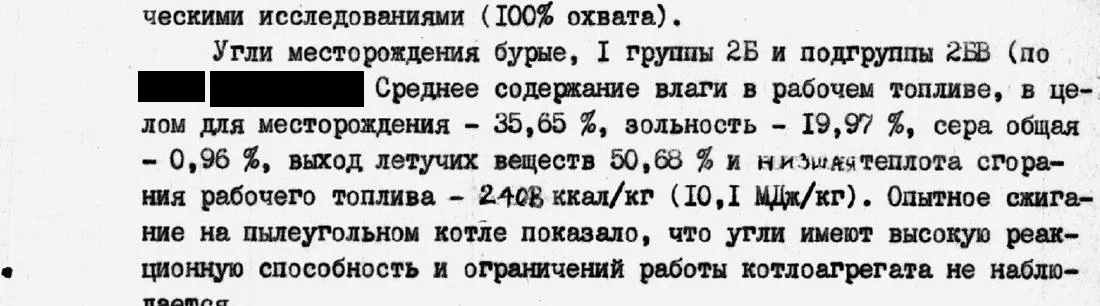
  • Brown coal, thermal (grade 2B (2Б)), non-coking
  • Stage: detailed exploration completed, reserves approved; on the state register as of 01.01.2011
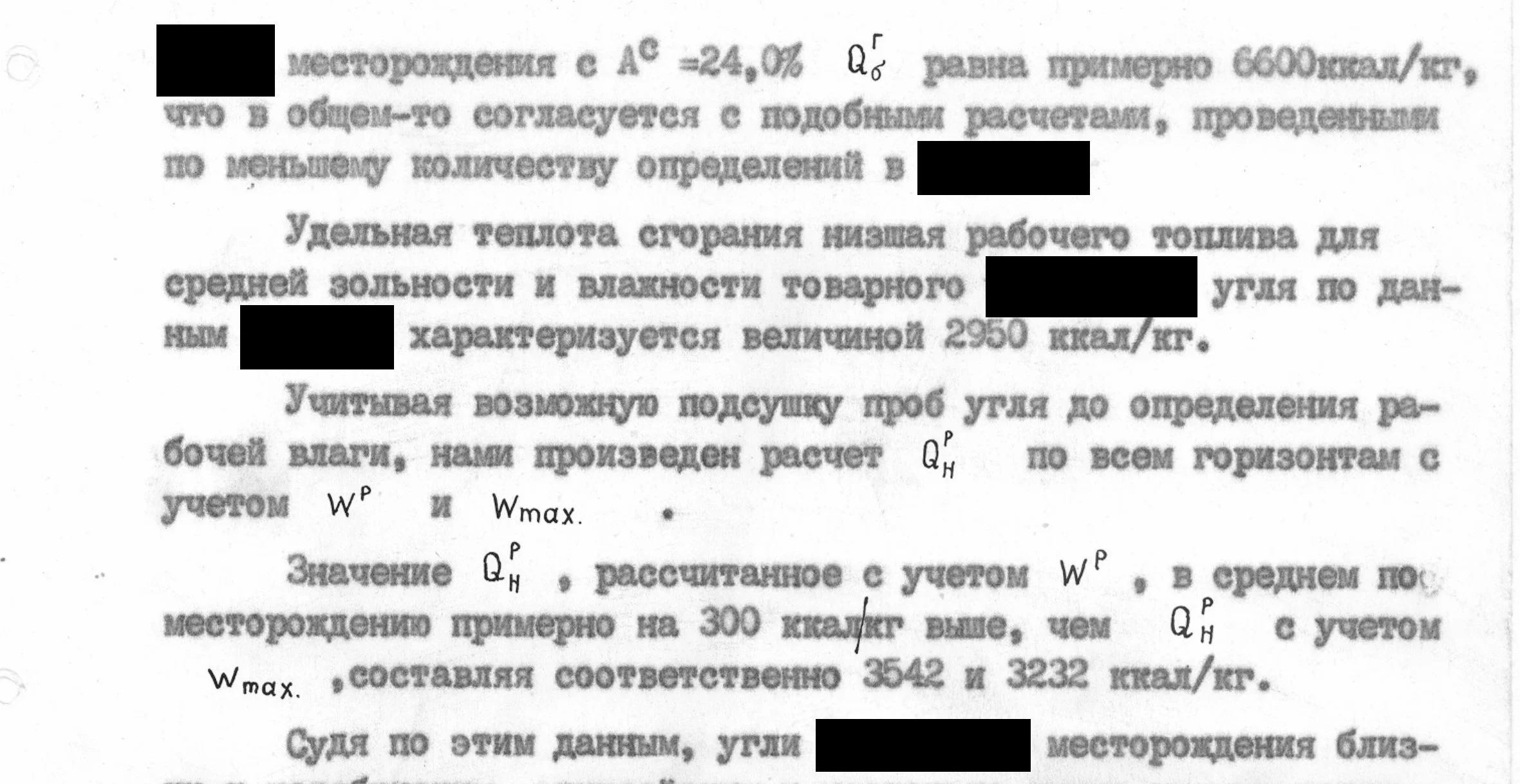
  • Net (lower) calorific value, as-received (working) fuel: 12–15 MJ/kg (2,950–3,542 kcal/kg per the report)
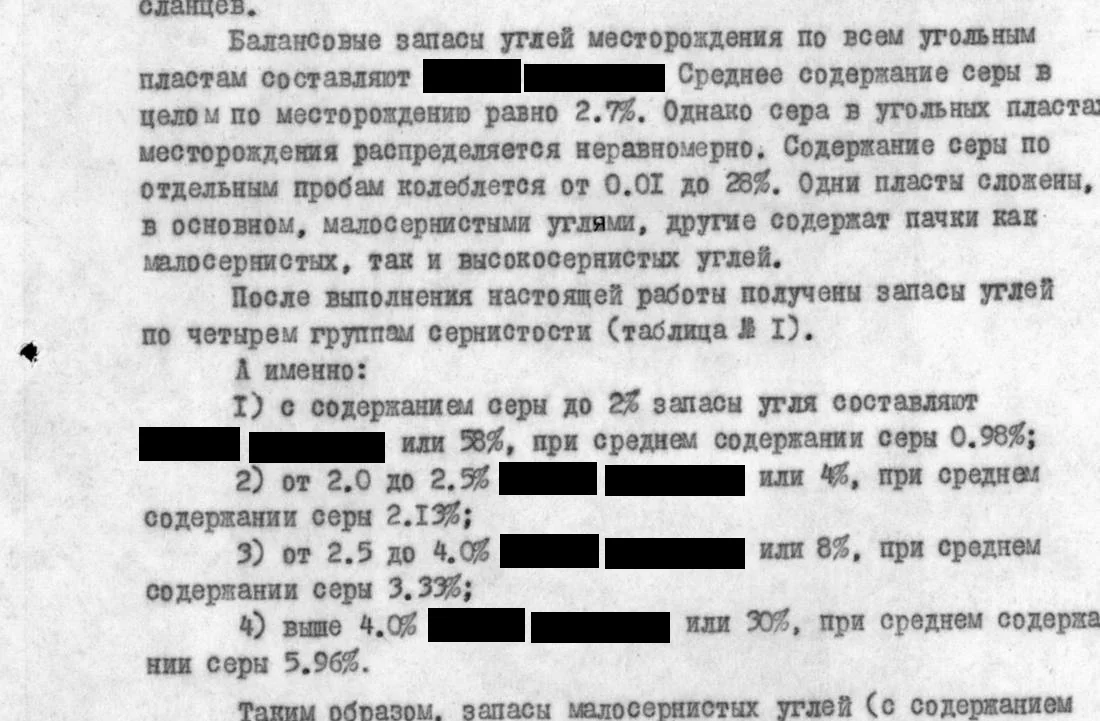
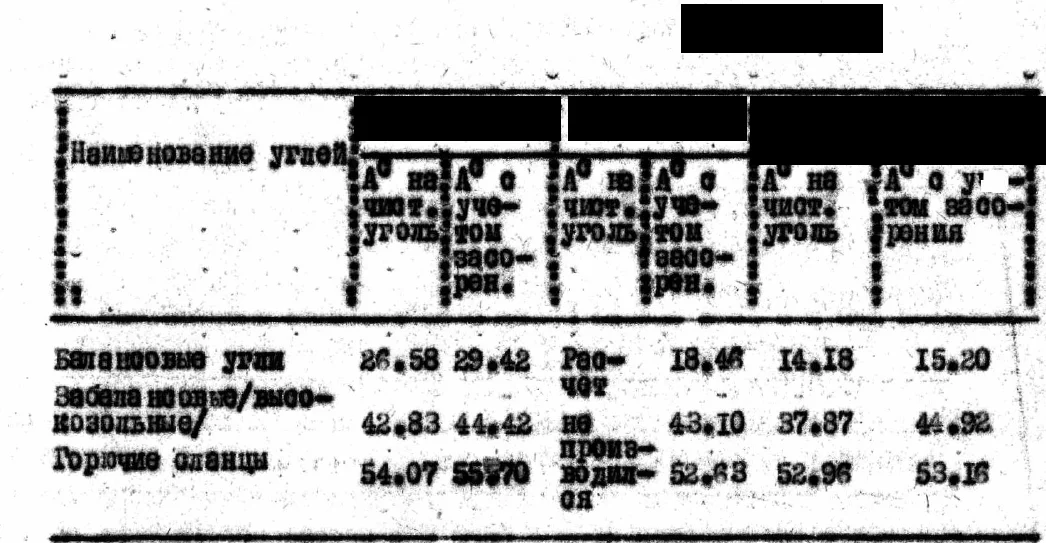
  • Sulphur about 1.2% on a dry-fuel basis; ash content about 20%, moisture about 34% (per the State Balance; the scan shows ash content of dry coal 24%)
  • Low-melting ash: the boiler should be selected with slagging in mind
  • Mining method: open-pit; the Soviet design provides for an open-pit mine of 25 million t of coal per year
  • The report's author named the deposit the most promising for priority development among the deposits explored in detail in its district
  • Reserve standard: Soviet classification (A, B, C1), this is not JORC

No active exploration or mining licences (per our check against the map)

Checked 11.11.2026; not an official extract.

Kostanay Region · approximate place, inside the circle
Fragment of an archival report, names hidden
QN-102

Coal

Kostanay Region

Reserves, categories A+B+C1 (Soviet calculation, approved by the USSR State Reserves Committee (GKZ)):

over 1 billion t

  • Brown coal, thermal (grade 2B (2Б)), non-coking
  • Stage: detailed exploration, reserves approved; a Soviet feasibility study (TEO) exists
  • Calorific value about 15 MJ/kg (as-received (working) fuel, per the State Balance)
  • Ash content of clean coal on average about 16% (per the TEO)
  • Sulphur on average about 2.4% — high: desulphurisation or blending with low-sulphur coal is needed
  • Mining method: open-pit; the TEO provides for one open pit of 20 million t of coal mass per year, average stripping ratio about 3.7 m³/t
  • Reserve standard: Soviet classification (A, B, C1), this is not JORC

No active exploration or mining licences (per our check against the map)

Checked 11.11.2026; not an official extract.

Kostanay Region · approximate place, inside the circle
Fragment of an archival report, names hidden
QN-103

Coal

Kostanay Region

Reserves, categories A+B+C1 (Soviet calculation, approved by the USSR State Reserves Committee (GKZ)):

over 1 billion t

  • Brown coal, thermal (grade 2B (2Б)), non-coking
  • Stage: detailed exploration, reserves approved; a Soviet technical council recognised the deposit as prepared for industrial development
  • Net (lower) calorific value, as-received (working) fuel: about 13 MJ/kg
  • Ash content about 16% (about 18% including dilution), moisture about 33%
  • Sulphur on average about 2.7%; more than half of the reserves have sulphur no higher than 2% (per the report)
  • Mining method: open-pit; a Soviet design institute considered open-pit mines
  • A railway crosses the deposit area
  • Reserve standard: Soviet classification (A, B, C1), this is not JORC

No active exploration or mining licences on the area; there is an active exploration licence in the vicinity (per our check against the map)

Checked 11.11.2026; not an official extract.

Kostanay Region · approximate place, inside the circle
Fragment of an archival report, names hidden
QN-106

Coal

Kostanay Region

Reserves, categories A+B+C1 (Soviet calculation, approved by the USSR State Reserves Committee (GKZ)):

200–500 million t

  • Brown coal, thermal (grade 2B (2Б)), non-coking
  • Stage: explored, reserves approved; on the state register as of 01.01.2011
  • Net (lower) calorific value, as-received (working) fuel: about 10 MJ/kg
  • Ash content about 20%, sulphur about 1%, moisture about 36%
  • Mining method: open-pit; Soviet materials refer to an open-pit mine
  • Reserve standard: Soviet classification (A, B, C1), this is not JORC

No active exploration or mining licences (per our check against the map)

Checked 11.11.2026; not an official extract.

Kostanay Region · approximate place, inside the circle
Fragment of an archival report, names hidden
QN-107

Coal

Akmola Region

Reserves, categories A+B+C1 (Soviet calculation, on the state register):

200–500 million t

  • Brown coal, thermal (grade 2B (2Б)), non-coking
  • Besides A+B+C1, about the same amount of category C2 reserves is on the register
  • Calorific value about 13 MJ/kg (per the State Balance)
  • Sulphur about 0.7% — low; ash content about 18%, moisture about 32%
  • Mining method not determined: two thick seams and a series of thin ones at depths of 110–570 m; prospecting did not identify areas for open-pit mining
  • Reserve standard: Soviet classification (A, B, C1, C2), this is not JORC

No active exploration or mining licences (per our check against the map)

Checked 11.11.2026; not an official extract.

Akmola Region · approximate place, inside the circle
QN-108

Coal

Kostanay Region

Reserves, category C1 (Soviet calculation, approved by a technical council):

50–200 million t

  • Brown coal, thermal (grade 2B (2Б)), non-coking
  • Stage: preliminary exploration; reserves approved by a technical council, not by GKZ
  • Calorific value of the as-received (working) fuel about 12 MJ/kg (per the State Balance); the scan gives the calorific value of laboratory fuel, dry fuel and combustible mass
  • Sulphur about 0.6%, moisture about 31%
  • Seams nearly horizontal, main seam over 15 m thick
  • Mining method: Soviet materials consider open pits and one underground mine; the report's authors judged the data insufficient for a final choice of method
  • Reserve standard: Soviet classification (C1), this is not JORC

No active exploration or mining licences on the area; at the boundary there is an active exploration licence (per our check against the map)

Checked 11.11.2026; not an official extract.

Kostanay Region · approximate place, inside the circle
Fragment of an archival report, names hidden
QN-109

Coal

Karagandy Region

Reserves, categories A+B+C1 (Soviet calculation, in the State Balance as of 01.01.2011):

200–500 million t

  • Hard coal, coking (grades Zh, KZh, K, OS (Ж, КЖ, К, ОС))
  • Stage: reserve area for an underground mine; besides A+B+C1, category C2 reserves are on the register
  • Ash content 10–30% (per the State Balance)
  • Mining method: underground; reserves calculated to a depth of 600 m
  • In a coal district with operating mines and a railway
  • Reserve standard: Soviet classification (A, B, C1, C2), this is not JORC

No active licences over most of the area; at the boundary there is an active right (per our check against the map)

Checked 11.11.2026; not an official extract.

Karagandy Region · approximate place, inside the circle
Contact